
Key Takeaways:
- Link Quality Value: Quality backlinks pass authority signals that help search engines trust and rank your content higher.
- Authority Value: Strong backlinks from reputable websites improve domain credibility and strengthen online visibility.
- Quality Over Quantity: A few relevant backlinks often deliver better SEO impact than hundreds of low-quality links.
- AI Search Impact: Backlinks help establish authority signals that AI search engines may use when evaluating sources.
- Referral Traffic: Relevant backlinks can drive qualified visitors who are genuinely interested in your content or services.
- Natural Link Earn: Creating valuable content increases the likelihood of earning backlinks without aggressive outreach efforts.
- Ranking Signals: Backlinks remain a major ranking factor that supports search performance across competitive industries.
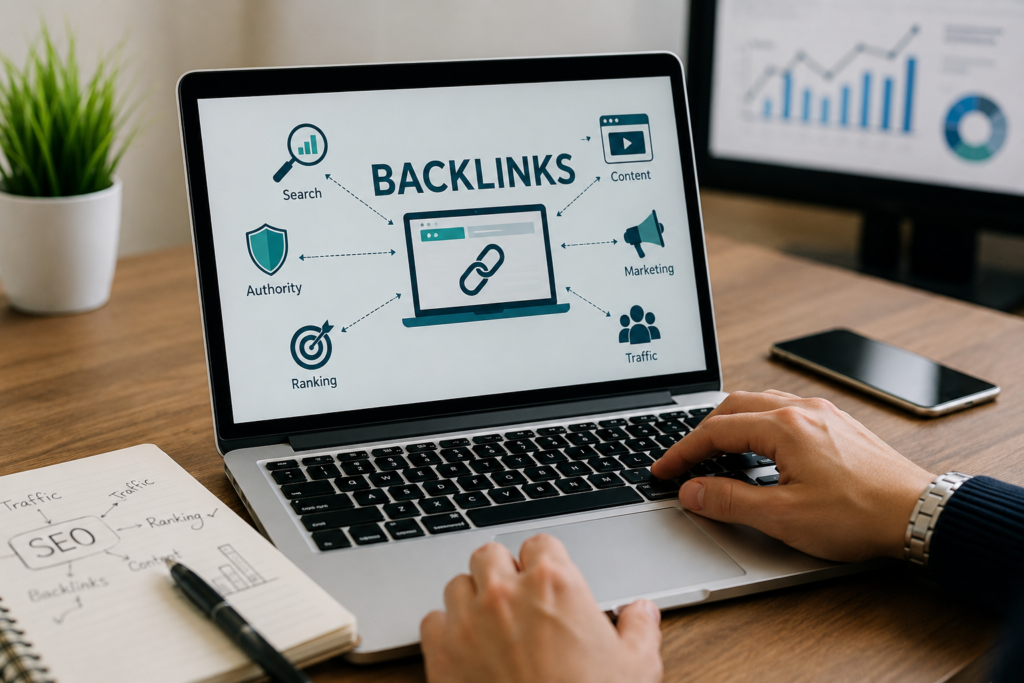
If you’ve spent any time learning about SEO, you’ve heard the word backlink. But beyond the buzzword, what does it actually mean, and why do search engines care so much about it? This guide breaks down everything you need to know about backlinks: what they are, how they work, the different types, and most importantly, how to build them the right way. Whether you’re a beginner or refining an existing strategy, this is your definitive reference.
Understanding Backlinks: Definition, Function, and SEO Impact
What Is a Backlink?
A backlink, also called an inbound link or incoming link is a hyperlink on one website that points to a page on another website. When Site A links to content on Site B, Site B receives a backlink from Site A.
Think of it like a citation in academic research. When reputable sources cite your work, it signals credibility. Search engines like Google use the same logic: if many trustworthy websites link to yours, your content is likely valuable and authoritative.
How Search Engines Interpret Backlinks
Google’s original PageRank algorithm was built on the premise that links are votes of confidence. Not all votes carry equal weight. A link from a high-authority domain like Forbes or BBC carries far more signal than a link from a new, obscure blog. Modern search algorithms evaluate hundreds of link-related factors, but the foundational principle remains: quality backlinks are one of the strongest ranking signals in existence.
Why Backlinks Matter for SEO
Backlinks serve three core functions in SEO and understanding each one helps you prioritize your link-building efforts.
- Ranking signals: Google has confirmed that backlinks remain one of its top three ranking factors. Pages with strong backlink profiles consistently outrank those without, especially in competitive niches.
- Crawlability: Search engine bots discover new pages by following links. A strong backlink profile ensures your content gets crawled and indexed faster.
- Referral traffic: High-quality backlinks don’t just help rankings they send real visitors to your site from other relevant pages and audiences.
Dofollow vs. Nofollow: What’s the Difference?
Not every backlink passes SEO value. Understanding the distinction between link types helps you assess your profile accurately.
- Dofollow links: The default link type. These pass “link equity” (commonly called link juice) to the destination page, directly influencing its authority and rankings.
- Nofollow links: Marked with rel=”nofollow”, these tell search engines not to pass authority. They still drive traffic and can contribute to a natural-looking link profile.
- Sponsored links: Used for paid placements or affiliate partnerships. Google requires these to be tagged with rel=”sponsored”.
- UGC links: User-generated content links (forum posts, comments). Tagged with rel=”ugc” to indicate their origin.
A healthy backlink profile includes a natural mix of all these types. Exclusively dofollow links from a narrow range of sources can look manipulative to Google’s algorithms.
Types of Backlinks: Not All Links Are Created Equal
Within the dofollow/nofollow spectrum, backlinks also differ by how they’re earned and where they appear. Here are the most common categories:
Editorial Backlinks
These are the gold standard. An editorial backlink is earned when a journalist, blogger, or website owner links to your content organically because it genuinely adds value to their piece. They require no outreach; you earn them by producing authoritative, original content that others want to reference. Editorial links from trusted domains carry the highest SEO weight.
Guest Post Backlinks
Write an article for another website in your industry and include a contextual link back to your own site. When done on relevant, high-quality publications with genuine editorial standards, guest posting is a legitimate and effective strategy. When done purely for link manipulation on low-quality sites, it violates Google’s guidelines.
Resource Page & Directory Backlinks
Many websites maintain curated lists of recommended tools, services, or references. Getting listed on a relevant, authoritative resource page can deliver consistent referral traffic and a solid backlink. Niche-specific directories are more valuable than generic ones.
What Makes a High-Quality Backlink?
Volume alone doesn’t win. One backlink from a relevant, authoritative domain can outperform hundreds from low-quality sources. When evaluating a potential backlink, consider these factors:
- Domain Authority (DA) / Domain Rating (DR): Metrics created by Moz and Ahrefs, respectively, that estimate a domain’s overall link authority on a 1–100 scale. Higher scores signal more value.
- Topical relevance: A link from a website in your niche carries more weight than one from an unrelated industry. Google’s algorithms assess context.
- Anchor text: The clickable text of the hyperlink. Descriptive, relevant anchor text (e.g., “best SEO tools for beginners”) provides more signal than generic text like “click here.”
- Link placement: Links embedded naturally within body content are more valuable than footer links, sidebar links, or links in boilerplate text.
- Page-level traffic: A backlink from a page that receives genuine organic traffic indicates real-world relevance, not just technical authority.
- Link diversity: Getting links from a wide range of unique domains is more valuable than accumulating many links from the same source.
Toxic Backlinks: When Links Hurt Instead of Help
Not every backlink is an asset. Low-quality, spammy, or manipulative links can actively harm your site’s standing with Google. Common sources of toxic links include:
- Link farms and private blog networks (PBNs) designed solely to manipulate rankings
- Irrelevant websites with no topical connection to your content
- Sites with thin, low-quality, or duplicated content
- Paid link schemes not disclosed with the rel=”sponsored” attribute
- Foreign-language directories with no contextual relevance
If you’ve inherited a toxic backlink profile from aggressive past link-building or a negative SEO attack, Google’s Disavow Tool allows you to request that certain links be ignored. Use this cautiously and only when you have clear evidence of harmful links that you cannot remove manually.
How to Build Backlinks: Proven Strategies That Work
Link building is a long game. Sustainable strategies focus on creating genuine value and building real relationships, not gaming the system. Here are the methods with the strongest track records:
Create Link-Worthy Content
The most scalable link-building strategy is producing content that people naturally want to cite. Original research, comprehensive guides, free tools, infographics, and data-backed case studies attract links because they serve as primary sources for other content creators. If your piece is the best answer to an important question, links follow.
Digital PR and Media Outreach
Reach out to journalists, bloggers, and media professionals with genuinely newsworthy angles, exclusive data, expert commentary, or a unique story tied to your brand. Platforms like HARO (Help a Reporter Out) connect sources with journalists actively looking for expert quotes, often resulting in high-authority editorial links.
The Broken Link Building Method
Find pages in your niche that link to dead URLs (404 errors). Reach out to the site owner, flag the broken link, and suggest your relevant content as a replacement. This is a high-conversion tactic because you’re solving a real problem for the webmaster while earning a backlink in return.
Skyscraper Technique
Identify content in your niche that has already attracted many backlinks. Create a significantly better, more comprehensive, or more updated version of that content. Then reach out to the websites linking to the original piece and introduce them to your superior resource. The keyword is “significantly,” a minor upgrade rarely convinces anyone to swap their link.
How to Audit and Monitor Your Backlink Profile
You can’t improve what you don’t measure. Regular backlink audits reveal your strengths, expose vulnerabilities, and uncover new opportunities. Here’s what a solid audit process looks like:
- Use dedicated SEO tools: Ahrefs, Semrush, and Moz all offer backlink analysis features. Pull your full link profile and export it for review. Cross-reference multiple tools for the most complete picture.
- Assess anchor text distribution: Look for over-optimization. If a high percentage of your backlinks use exact-match keyword anchors, that’s a red flag for Google’s Penguin algorithm.
- Check linking domain diversity: A healthy profile draws from many unique root domains. If most of your links come from a handful of sources, prioritize diversification.
- Monitor new and lost links: Set up alerts for new backlinks and lost backlinks. Losing links from high-authority sources is a signal to investigate it could be due to content removal, site redesigns, or editorial changes.
- Identify and disavow toxic links: Flag suspicious links and attempt manual removal first. If the site owner doesn’t respond, use Google’s Disavow File as a last resort.
Backlinks vs. Internal Links: Understanding the Relationship
Backlinks are external votes of confidence; internal links are your own architectural choices. Both matter for SEO, and they work in concert. Internal links distribute the authority gained from backlinks throughout your site, directing link equity to high-priority pages that may not attract many external links on their own. A strong backlink profile without thoughtful internal linking leaves authority stranded.
The practical implication: when you earn a backlink to a high-authority page, ensure that page links internally to the key commercial or cornerstone content you want to rank. This creates a deliberate flow of authority across your site architecture.
Backlinks in the Age of AI Search: Do They Still Matter?
As AI-powered search (Google AI Overviews, ChatGPT Search, Perplexity) reshapes how people find information, some have questioned whether traditional link-building still applies. The answer, for now, is clearly yes with nuance.
AI search engines still rely on indexing web content and prioritize pages that demonstrate E-E-A-T (Experience, Expertise, Authoritativeness, Trustworthiness). Backlinks from credible sources remain one of the strongest external signals of authoritativeness. Research suggests that pages cited in AI Overviews and AI-generated answers consistently display strong backlink profiles.
What’s shifting: the emphasis is moving toward citation-worthiness over volume. Being mentioned and linked to by authoritative sources in your space not just accumulating numbers is what positions your content for visibility in AI-driven results.
Quick Reference: Backlinks at a Glance
- What is a backlink? A hyperlink from one website to another, acting as a vote of credibility.
- Why do backlinks matter? They are a top-3 Google ranking signal and drive referral traffic.
- Best type of backlink? Editorial links from high-authority, topically relevant domains.
- Dofollow vs. nofollow? Dofollow passes link equity; nofollow does not but both have value.
- Can backlinks hurt you? Yes toxic or spammy links can trigger Google penalties.
- How to build backlinks? Create valuable content, pitch digital PR, use guest posts, fix broken links.
- How to check backlinks? Use tools like Ahrefs, Semrush, Moz, or Google Search Console.
- Do backlinks matter for AI search? Yes authoritativeness signals, including backlinks, influence AI citation.
Final Takeaway
Backlinks remain one of the strongest signals of trust, relevance, and authority in modern search ecosystems. As search engines and AI-powered discovery platforms continue to evolve in 2026, the focus is no longer on acquiring the highest number of links, but on earning meaningful, high-quality references from credible sources. Businesses that invest in valuable content, strategic digital PR, and authentic relationship building are better positioned to strengthen visibility, improve rankings, and establish long-term authority within their industry.
Looking ahead, backlinks will play an increasingly important role in how brands are evaluated across both traditional search and AI-generated recommendations. A well-planned link-building strategy can create lasting competitive advantages, drive qualified traffic, and support sustainable organic growth. If your organization is looking to strengthen its digital presence, the team at Pixel Technolabs can help you develop scalable SEO and content strategies that align with evolving search trends and business goals.