
Key Takeaways:
- GBP Is #1: Your Google Business Profile is the single most important local SEO asset for any clinic.
- NAP Consistency: Uniform name, address, and phone data across all directories directly strengthens local rankings.
- Reviews Drive Rank: Google factors review volume, recency, and rating into local search rankings ask every patient.
- Mobile Comes First: Over 60% of local health searches are on mobile; slow sites lose both patients and search positions.
- One Page Per Service: Dedicated service pages outperform combined pages by targeting specific, high-intent patient queries.
- Content Compounds: Local blog posts and FAQs build authority over time and attract organic traffic long after publishing.
- Schema Markup Helps: Structured data tells Google exactly what your practice offers, improving visibility and click rates.
- Pick the Right Agency: The best dental SEO company will show transparent reporting, healthcare experience, and no black-hat tactics.
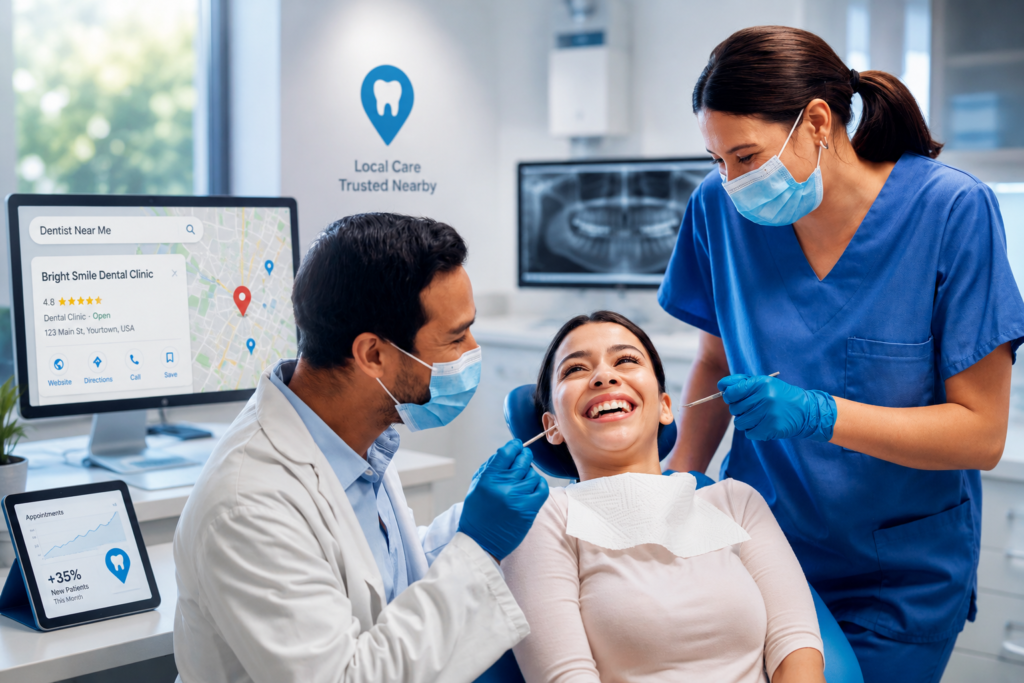
Most patients searching for a dentist or clinic don’t scroll past the first three results. They pick from what Google shows them, book an appointment, and move on. If your practice isn’t appearing in those results, you’re not losing to competitors with better care; you’re losing to competitors with better local SEO.
Dental SEO services exist to close that gap. They combine technical website optimization, local search strategy, and content development to make sure Google understands who you are, where you are, and why patients in your area should choose you. This guide breaks down how it works, what matters most, and why investing in digital marketing for dentists is no longer optional for practices that want to grow.
Why Local SEO Is the Growth Engine Medical Practices Can’t Ignore
Local SEO is the discipline of making your business visible to people searching for services near them. For medical practices, this is especially high-stakes: a patient in pain or with an urgent need will search, find, decide, and book often within minutes.
Google’s local search results surface three types of content: the Local Pack (the map with three listings), organic search results, and paid ads. Dental SEO services target the first two, which together capture the overwhelming majority of patient clicks.
What makes local SEO different from general SEO is its geographic precision. Ranking nationally for “teeth whitening” is nearly worthless for a single-location dental clinic. Ranking for “teeth whitening dentist in Austin” or even “teeth whitening near me” is what actually fills chairs.
The practices that dominate local search aren’t doing anything mysterious. They’ve consistently applied a handful of proven strategies that, together, tell Google they’re the most relevant, trustworthy answer for patients nearby.
Google Business Profile: Your Most Valuable Local SEO Asset
If there’s one thing you do first, it’s this: claim, verify, and fully optimize your Google Business Profile (GBP). This free listing powers your presence on Google Maps and in the Local Pack.
An incomplete or unoptimized GBP leaves significant visibility on the table. A fully built-out profile includes:
- Accurate NAP data: Name, Address, and Phone number, formatted consistently with how it appears everywhere else online
- Business category selection: Primary category (e.g., “Dentist”) and all relevant secondary categories
- Services listed: Preventive care, cosmetic dentistry, orthodontics, emergency appointments, etc.
- Operating hours: Including holiday hours, updated regularly
- Photos: Exterior, reception area, treatment rooms, and staff headshots (practices with photos get significantly more profile visits)
- Appointment booking link: Directly connected to your scheduling system
- Q&A section: Proactively answer common patient questions before they have to ask
Responding to reviews through your GBP also matters. Google reads engagement signals. A practice that responds to every review, positive or negative, signals an active, trustworthy business worth surfacing.
NAP Consistency and Local Citations
Here’s where many practices quietly lose ground. If your practice name, address, or phone number appears differently across directories Yelp, Healthgrades, Zocdoc, WebMD, your own website Google’s confidence in your business information erodes. That eroded confidence translates directly to lower local rankings.
Local citations are mentions of your practice across the web. Building a clean, consistent citation footprint across authoritative directories is a foundational piece of any dental SEO services strategy:
- Ensure NAP is identical everywhere, even small variations like “St.” vs. “Street” create inconsistency signals
- Prioritize healthcare-specific directories: Healthgrades, Vitals, Zocdoc, WebMD, and Yelp
- Don’t neglect general directories: Google, Apple Maps, Bing Places, Facebook, and the Better Business Bureau
- Audit and correct existing citations before building new ones, cleaning bad data matters more than adding volume
This isn’t glamorous work. But it’s the kind of SEO best practice that separates practices with stable, growing local visibility from those that wonder why their rankings fluctuate unexpectedly.
On-Page SEO Making Your Website Speak Google’s Language
Your website needs to do two things simultaneously: convince visiting patients you’re the right choice, and convince Google you’re relevant for local searches. These goals aren’t in conflict, but they do require deliberate execution.
Key On-Page Elements for Medical and Dental Websites
Location-specific page titles and meta descriptions: Every page should include your city or region in the title tag. “Cosmetic Dentistry | Smith Dental | Dallas, TX” outperforms “Cosmetic Dentistry Services” for local relevance.
Dedicated service pages: One page per core service, rather than cramming everything onto a single “Services” page gives each offering a chance to rank independently. A page dedicated to “dental implants in Phoenix” will always outperform a paragraph buried on a general services page.
Embedded Google Map: Include an embedded map on your contact and location pages. It reinforces geographic relevance to search engines and improves the experience for patients looking to visit.
Schema markup: LocalBusiness and MedicalBusiness structured data help Google understand your practice type, location, hours, and services without ambiguity. This is standard practice for any competent digital marketing agency working in healthcare.
Mobile optimization: More than 60% of local health searches occur on mobile devices. Slow-loading, poorly formatted mobile pages are a direct conversion problem and a ranking problem, since Google prioritizes mobile experience in its core ranking signals.
Patient Reviews The Ranking Signal Most Practices Underinvest In
Reviews are arguably the most persuasive element in local search. They influence two things simultaneously: Google’s ranking algorithm (volume, recency, and rating all factor in) and the patient’s decision to book.
Practices with fewer than 20 Google reviews are at a measurable disadvantage compared to competitors with 100+ reviews. The fix isn’t complicated, but it does require consistency:
- Ask every satisfied patient for a review verbally, by text follow-up, or via email
- Make it easy with a direct Google review link (shortened and placed in follow-up messages)
- Respond to every review within 48 hours, thank positive reviewers specifically, and address negative reviews calmly and professionally
- Never incentivize reviews or post fake ones; Google penalizes this, and it’s not worth the risk
Online marketing for dentists often focuses on acquiring new patients, but reviews work quietly in the background, building the social proof that makes every other marketing channel more effective.
Local Content Strategy Giving Google a Reason to Rank You
Publishing content about local dental topics is one of the most durable ways to build local search authority over time. It works because it creates relevance signals that generic directory listings can’t replicate.
Effective local content for dental and medical practices includes:
- Neighborhood-specific pages: If you serve multiple suburbs or districts, a dedicated page for each builds hyper-local relevance
- Patient education blog posts: “What to expect during a root canal” or “How often should you replace your toothbrush?” attract informational searches that build trust and organic traffic
- FAQ pages: Answer the questions patients actually type into Google: “Does dental insurance cover implants?” “How long does teeth whitening last?”
- Seasonal and event content: Back-to-school dental checkups, holiday hours announcements, and local community involvement
This is where digital marketing services for medical practices diverge from basic directory management. Content compounds over time. A well-written article published today can generate patient inquiries two years from now.
Technical SEO: The Foundation Underneath Everything Else
Technical SEO covers the elements patients never see but Google always does. A site with excellent content and strong reviews can still underperform if its technical foundation is weak.
Core technical priorities for medical practice websites:
- Page speed: Under 3 seconds load time on mobile is the practical threshold; anything slower loses patients and rankings
- HTTPS security: Non-secure sites (HTTP) are flagged in browsers and deprioritized by Google
- Crawlability Search engines need to be able to access and index all your key pages without errors
- Duplicate content: Multiple pages with the same or very similar content confuse search engines and dilute ranking signals
- Core Web Vitals: Google’s user experience metrics (Largest Contentful Paint, Cumulative Layout Shift, Interaction to Next Paint) now directly influence rankings
Working with a digital marketing agency that understands both the technical and clinical context of healthcare websites makes a meaningful difference here. Medical sites carry specific trust requirements YMYL (Your Money or Your Life) content that Google holds to a higher standard.
Choosing the Right Dental SEO Partner
Not every agency understands the compliance sensitivities, the competitive dynamics, or the patient journey that’s specific to dental and medical marketing. When evaluating dental SEO services or looking for the best dental SEO company for your practice, consider:
- Healthcare-specific experience: Have they worked with HIPAA-aware content practices? Do they understand medical disclaimers?
- Transparent reporting: Can they show you keyword rankings, GBP visibility, organic traffic, and lead conversion data not just vanity metrics?
- Local SEO depth: Beyond basic citation building, do they execute a full local strategy including content, technical work, and review management?
- No black-hat tactics: Purchased links, fake reviews, and keyword stuffing still surface in agency proposals. They produce short-term results and long-term penalties.
A credible digital marketing agency in USA with healthcare clients will be comfortable walking you through their process, their case studies, and how they measure success for practices like yours.
Conclusion
Local search visibility isn’t a marketing luxury for dental and medical practices it’s directly connected to how many patients walk through the door. The practices that dominate Google Maps and local search results aren’t spending more on ads; they’re investing in the right combination of dental SEO services: a fully optimized Google Business Profile, consistent citations, strategic on-page content, and a steady stream of genuine patient reviews. Each element reinforces the others, and the cumulative effect builds a presence that’s genuinely difficult for competitors to displace.
The healthcare market is only getting more competitive online, and the window for easy local wins is narrowing. Practices that act now build an advantage that compounds over months and years. If you’re ready to turn your website from a digital brochure into a patient acquisition engine, Pixel Technolabs works with medical and dental businesses to build that kind of durable, measurable local presence , no inflated promises, just a clear strategy and results you can track.