
Key Takeaways:
- Find Real Rivals: Identify business, organic, local, and AI search competitors.
- Close Keyword Gaps: Target high-intent, long-tail, and missed competitor keyword opportunities.
- Build Better Content: Improve search intent, topic depth, structure, and information value.
- Strengthen Backlinks: Use backlink gaps to find relevant link-building and authority opportunities.
- Optimize for AI Search: Improve AIO, GEO, local SEO, and brand visibility across AI platforms.
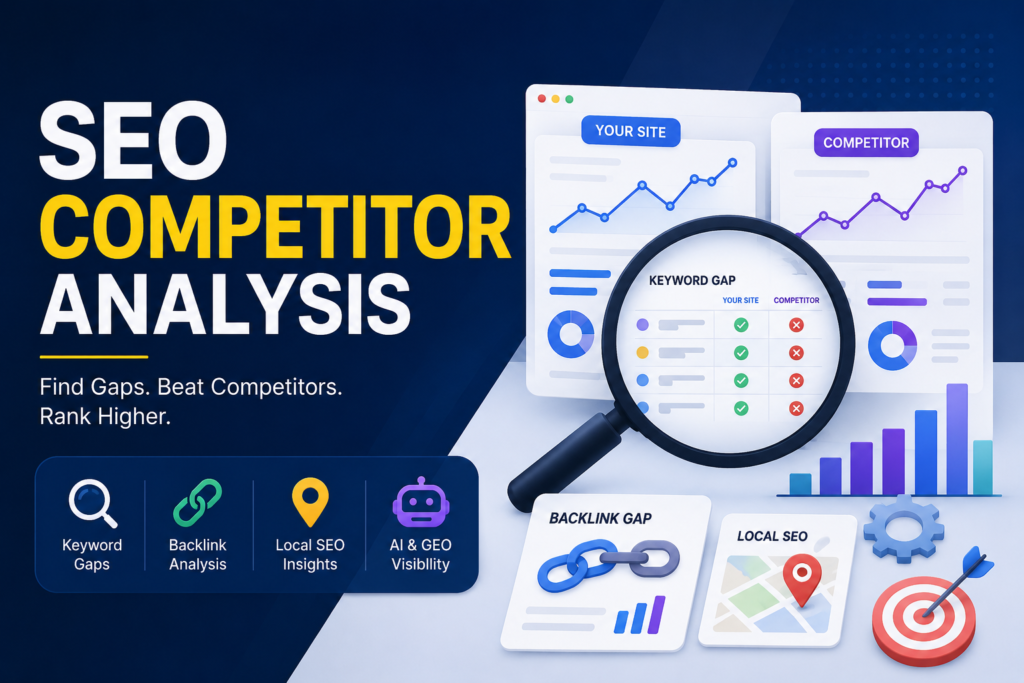
Ranking higher in search is rarely about publishing more content than everyone else. It is about understanding where competitors are already winning, why they are winning, and which opportunities they have overlooked.
That is exactly what an SEO competitor analysis helps you uncover.
A modern competitive analysis goes far beyond checking which keywords another website ranks for. Search visibility today spans traditional Google results, local search, Google AI Overviews, AI Mode, ChatGPT, Perplexity, community discussions, third-party mentions, backlinks, and other discovery channels.
Businesses therefore need to understand not only who ranks above them, but also which brands are being cited, recommended, linked to, discussed, and trusted across the wider search ecosystem.
This guide explains how to conduct an SEO competitive analysis from beginning to end, including keyword gaps, search intent, long-tail keywords, backlinks, link building, local SEO, AI Overview optimization, and Generative Engine Optimization (GEO).
What Is SEO Competitor Analysis?
SEO competitor analysis is the process of evaluating websites that compete with your business for visibility in organic search and other search-driven discovery channels.
The purpose is not to copy competitors.
It is to understand:
- What keywords they rank for
- Which pages generate visibility
- Which topics they cover better than you
- What search intent they target
- Where their backlinks come from
- Which content earns links
- How strong their topical authority is
- Where they appear in AI-generated answers
- How they perform in local search
- Which opportunities they have missed
An important distinction is that your SEO competitors may not be the same as your business competitors.
For example, a software development company may compete commercially with other development agencies. But for a query such as “how much does custom software development cost,” its organic competitors could include research websites, technology publications, consulting firms, SaaS businesses, or industry blogs.
Semrush recommends identifying both direct business competitors and organic competitors because both can compete for the same search visibility. It also suggests beginning with roughly three to five competitors so the analysis remains focused and actionable.
Why SEO Competitive Analysis Matters More in the AI Search Era
Traditional SEO competitive analysis concentrated heavily on ten blue links.
That model is no longer sufficient.
Searchers can now discover companies through:
- Standard organic results
- Featured snippets
- Google AI Overviews
- Google AI Mode
- Local packs
- Google Maps
- YouTube
- Reddit and community discussions
- Review websites
- ChatGPT
- Perplexity
- Other generative search experiences
Semrush specifically recommends evaluating competitors’ AI visibility and identifying prompts where competitors appear but your brand does not.
This changes the central question from:
“Which competitor ranks above us?”
to:
“Which competitor is most visible and trusted throughout the complete discovery journey?”
That broader question is the foundation of modern SEO, AIO, and GEO strategy.
Step 1: Identify Your Real SEO Competitors
Start by separating competitors into different groups.
Direct competitors
These companies sell similar products or services to the same audience.
Organic search competitors
These websites frequently appear for the keywords you want to rank for, regardless of whether they offer exactly the same service.
Local competitors
These businesses compete with you in a particular city, state, country, neighborhood, or service area.
AI visibility competitors
These are brands, publications, marketplaces, directories, or other sources that AI engines repeatedly mention when users ask questions related to your services.
Your AI competitors can differ considerably from your Google competitors.
To identify competitors, search your major commercial and informational queries manually.
For example:
- SEO services
- SEO company
- enterprise SEO services
- SEO agency near me
- SEO competitor analysis
- how to improve organic traffic
- best SEO company for SaaS businesses
Then repeat important queries across Google, AI platforms, YouTube, Reddit, and industry-specific websites.
Document domains that repeatedly appear.
You should eventually have a shortlist of roughly three to five primary competitors plus additional competitors for specific areas such as local SEO or AI search.
Step 2: Build a Competitor SEO Benchmark
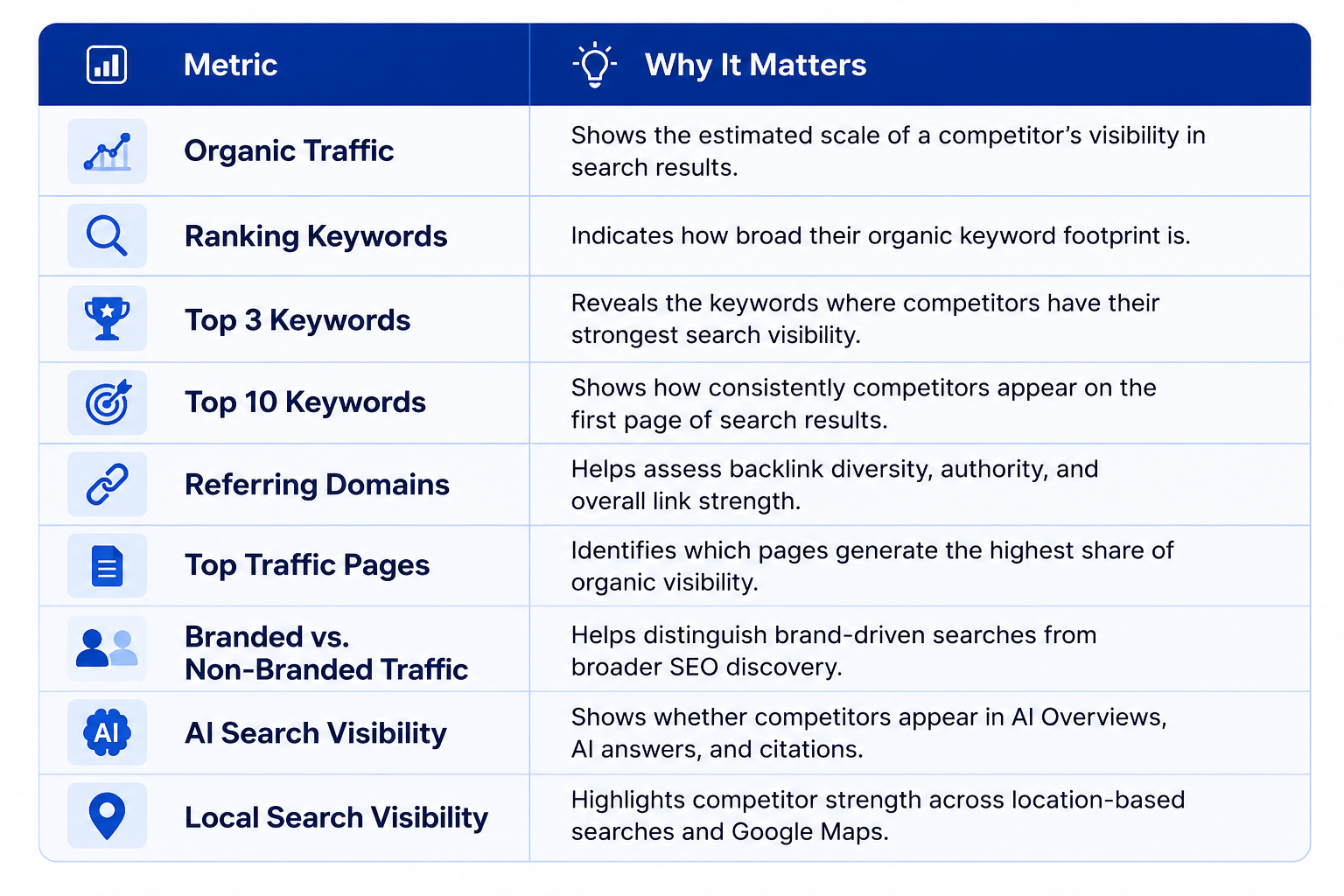
Before analyzing individual keywords, backlinks, or content gaps, create a clear benchmark of how your website performs against key competitors.
The goal is not to compare every available SEO metric. Instead, focus on the indicators that reveal where competitors are stronger, how they are gaining visibility, and which areas deserve deeper analysis.
Start by comparing:
Look for Patterns, Not Just Bigger Numbers
A competitor having more traffic or backlinks does not automatically explain why they are performing better.
Look for patterns such as:
- Is one competitor growing faster than the rest of the market?
- Are they ranking for more commercial or transactional keywords?
- Do a small number of pages generate most of their organic visibility?
- Are they earning referring domains consistently?
- Do they dominate a particular topic or service category?
- Are they appearing more frequently in AI Overviews or generative search results?
- Are they significantly stronger in specific cities or service areas?
These patterns can help you identify where to investigate next.
Step 3: Run a Competitor Keyword Gap Analysis
A keyword gap analysis identifies valuable searches for which competitors rank but your website does not.
This is one of the highest-value parts of SEO competitor research.
Do not simply export thousands of competitor keywords and start creating pages.
Filter them based on:
Business relevance
Does the search relate directly to something your organization sells or wants authority around?
Search intent
Is the search informational, commercial, navigational, or transactional?
Search demand
Does enough demand exist to justify the investment?
Ranking feasibility
Can your domain realistically compete?
Conversion potential
Could the query ultimately generate leads, sales, subscriptions, or other meaningful business outcomes?
Semrush specifically recommends using intent filters when studying missing keywords and warns against prioritizing a keyword purely because its search volume appears attractive.
That distinction is important.
A keyword with 20,000 searches and weak business relevance could be significantly less valuable than a highly specific query with 300 searches that regularly produces qualified leads.
Step 4: Prioritize High-Intent and High-Opportunity Keywords
Once you have the keyword gap, categorize opportunities according to their position in the buyer journey.
Informational intent
Examples:
- what is SEO competitor analysis
- how to analyze competitor keywords
- how does backlink gap analysis work
These are useful for building awareness and topical authority.
Commercial investigation intent
Examples:
- best SEO competitor analysis tools
- SEO agency vs in-house SEO
- best enterprise SEO agencies
- local SEO services comparison
These queries often indicate that a user is evaluating options.
Transactional intent
Examples:
- hire SEO agency
- enterprise SEO services
- local SEO company near me
- SEO consulting services
These usually deserve greater commercial priority.
Create an opportunity score combining:
Relevance × Intent × Demand × Ranking Feasibility × Conversion Potential
This prevents teams from chasing traffic that has little connection to revenue.
Step 5: Find Long-Tail Keyword Gaps
Competitive analysis should not stop with high-volume head terms.
Long-tail keywords can provide some of the strongest opportunities because they frequently reveal exactly what the searcher needs.
Instead of focusing only on:
SEO competitor analysis
look for variations such as:
- how to conduct SEO competitor analysis
- SEO competitor analysis for small businesses
- how to find competitors’ ranking keywords
- how to perform backlink competitor analysis
- competitor keyword gap analysis for SaaS
- local SEO competitor analysis checklist
- how to analyze competitors for Google Maps
- how to find backlink opportunities from competitors
- how to optimize content for AI Overviews
These terms may individually receive fewer searches, but they often have clearer intent and less ambiguous competition.
Long-tail analysis also supports AIO and GEO because conversational AI queries tend to be longer and more context-rich than traditional search terms.
Step 6: Analyze Competitors’ Topic Clusters
Keywords should not be evaluated as isolated phrases.
Group competitor keywords into topic clusters.
For an SEO website, those clusters might include:
Technical SEO
- crawlability
- indexing
- Core Web Vitals
- site architecture
- schema
Content SEO
- content optimization
- keyword research
- search intent
- topical authority
Link Building
- backlinks
- digital PR
- link building
- backlink audits
Local SEO
- Google Business Profile
- local citations
- Google Maps rankings
- reviews
Compare those clusters against your website.
You may discover that you already have one article about a subject while competitors have developed an entire interconnected content ecosystem.
That is a topic gap, not merely a keyword gap.
Search engines and generative engines increasingly need enough context to understand what an organization is knowledgeable about. Building comprehensive topic clusters can strengthen this authority.
Step 7: Reverse Engineer Competitors’ Best-Performing Content
Identify competitor pages that:
- Rank for important keywords
- Rank for multiple related keywords
- Earn strong backlinks
- Generate significant organic traffic
- Appear in AI Overviews
- Receive AI citations
- Win featured snippets
- Generate discussion or shares
Then analyze why.
Look at:
Search intent alignment
Does the content answer exactly what the query asks?
Content depth
Does it provide enough detail without unnecessary filler?
Structure
Analyze H1, H2, and H3 hierarchy.
Information gain
Does the page contribute anything competitors do not?
This might include:
- Original research
- Statistics
- Templates
- Checklists
- Expert commentary
- Case studies
- Calculators
- Frameworks
- Comparative data
- Real examples
E-E-A-T signals
Look for:
- Named authors
- Expert credentials
- Original research
- Case studies
- Reliable sources
- Editorial review
- Transparent company information
User experience
Check readability, page speed, navigation, visual hierarchy, tables, videos, diagrams, FAQs, and mobile performance.
Semrush recommends analyzing both the editorial angle and structural choices of high-performing competitor pages instead of blindly reproducing their headings. Original research and unique frameworks can also create backlink and AI citation opportunities.
Your objective should therefore be:
Match the search intent, cover essential subtopics, and add information the existing results do not provide.
Step 8: Conduct a Backlink Gap Analysis
Backlinks remain an important part of competitive SEO research.
A backlink gap analysis identifies domains that link to competitors but do not link to your website.
Start by comparing:
- Total backlinks
- Referring domains
- Relevant referring domains
- Authority of referring sites
- Anchor text
- Linked pages
- New versus lost links
- Link acquisition velocity
Semrush defines backlink-gap analysis specifically as identifying domains that link to competing websites but not your own.
But finding the gap is only the first step.
You need to determine why the competitor earned the backlink.
Was the link generated by:
- Original research?
- A statistics page?
- Industry report?
- Free tool?
- Case study?
- Guest contribution?
- Expert quote?
- Partnership?
- Directory profile?
- Product review?
- Resource guide?
- Digital PR campaign?
The reason behind a backlink is often more useful than the backlink itself.
Step 9: Convert Backlink Gaps Into Link-Building Opportunities
After identifying valuable referring domains, classify them.
Replicable links
These are opportunities where the same website could reasonably link to your business.
Examples include resource pages, directories, industry roundups, partner pages, and comparison content.
Content-driven links
The publisher linked because a competitor produced useful research, statistics, templates, guides, or tools.
Instead of simply requesting a backlink, produce something genuinely more useful.
PR-driven links
Competitors may earn links from news sites through research, announcements, commentary, expert opinions, or industry data.
Relationship-driven links
Associations, technology partners, clients, vendors, events, universities, and industry organizations can create legitimate authority signals.
Prioritize relevance and quality over raw backlink volume.
One highly relevant industry link can have substantially more strategic value than dozens of unrelated low-quality placements.
Step 10: Analyze Competitors for AIO and GEO
This is where modern competitive research becomes significantly different from old-school SEO.
AIO: AI Overview Optimization
Evaluate which competitor pages are surfaced or cited within Google AI Overviews.
Look for patterns:
- What questions trigger AI Overviews?
- Which competitor domains are cited?
- Which pages receive citations?
- What sections of those pages answer the question?
- Are citations coming from ranking pages or different sources?
- Does the competitor provide concise definitions, lists, comparisons, statistics, or step-by-step answers?
GEO: Generative Engine Optimization
Repeat this analysis across generative platforms.
Test prompts such as:
- What are the best companies for [service]?
- Which companies specialize in [solution]?
- How should a business solve [problem]?
- What are the leading tools for [use case]?
- Compare [solution category] providers.
- What should I look for when hiring a [service provider]?
Record:
- Brands mentioned
- Sources cited
- Order of recommendations
- Description of each brand
- Sentiment
- Missing brands
- Common cited domains
Semrush’s current competitor-analysis methodology similarly recommends identifying prompts where competitors are visible but your brand is absent.
Step 11: Build Content That Is Easier for AI Systems to Understand and Cite
Do not treat GEO as keyword stuffing for AI.
Create content that is easy to extract, understand, verify, and reference.
Helpful practices include:
- Give direct answers near relevant headings
- Use clear entity names
- Explain concepts before adding complexity
- Include descriptive H2s and H3s
- Use comparison tables
- Include factual statistics with sources
- Add expert commentary
- Publish original research
- Use FAQ sections where they genuinely help
- Keep company information consistent across the web
- Strengthen author and organization credibility
- Build third-party mentions
- Use relevant structured data
The strongest AIO and GEO strategy combines on-site clarity with off-site authority.
A company saying it is an expert is weak evidence.
Independent websites, customers, publications, communities, associations, and respected experts discussing that company create much stronger corroborating signals.
Step 12: Analyze Competitors’ Off-Site Brand Presence
Modern search visibility extends beyond a company’s domain.
Investigate competitor mentions across:
- Quora
- YouTube
- Review websites
- Industry publications
- Comparison websites
- Directories
- Podcasts
- Forums
- News websites
Semrush notes that community discussions and social content can surface in search and AI experiences even though social activity itself is not a direct Google ranking factor.
Ask:
Where are customers discussing competitors?
What questions do they ask?
What complaints repeatedly appear?
What strengths do users mention?
Which external sites influence purchasing decisions?
These insights can improve not only SEO but also content positioning, messaging, product strategy, and GEO visibility.
Step 13: Run a Local SEO Competitor Analysis
If your company serves particular geographic markets, include local SEO competitor analysis.
Analyze each competitor’s:
Google Business Profile
Review:
- Primary category
- Secondary categories
- Business description
- Services
- Products
- Photos
- Posts
- Q&A
- Business attributes
Reviews
Compare:
- Number of reviews
- Average rating
- Review frequency
- Recent reviews
- Owner responses
- Common customer language
Local rankings
Track queries with geographic modifiers:
- [service] near me
- [service] in [city]
- best [service] in [city]
- [service] company [city]
- [service] [neighborhood]
Do not measure only city-wide rankings.
Google Maps visibility can differ dramatically a few blocks apart, so grid-based local rank tracking can provide a more realistic picture.
Semrush also recommends checking competitors’ Google Business Profiles, reviews, local rankings, and even their presence in AI results for geographically specific searches.
Step 14: Analyze Local Citation and Backlink Gaps
For local businesses, check whether competitors are listed or linked on:
- Local directories
- Chambers of commerce
- Business associations
- Industry associations
- Local news websites
- Sponsorship websites
- Community resources
- Regional publications
- Relevant vendor directories
These opportunities can improve local authority while building broader brand visibility.
Consistency in business name, address, phone number, categories, website details, and service information is also important when building local citations.
Step 15: Evaluate Competitor On-Page SEO
For strategically important competitor pages, evaluate:
- Title tag
- Meta description
- URL
- H1
- Heading hierarchy
- Primary keyword usage
- Related entities
- Internal links
- External references
- Images
- Image alt text
- Schema markup
- FAQs
- Content freshness
- CTAs
Do not copy keyword density.
Instead, analyze semantic coverage.
What entities, concepts, questions, problems, and supporting terms consistently appear across high-ranking pages?
Then determine what information users genuinely need.
Step 16: Check Competitor Technical SEO
Content cannot perform at its full potential if the technical foundation is weak.
Benchmark competitors across:
- Core Web Vitals
- Mobile experience
- Crawlability
- Indexability
- HTTPS
- Canonicalization
- JavaScript rendering
- XML sitemaps
- Robots directives
- Site architecture
- Pagination
- Schema markup
- Duplicate content
- Internal linking
- Page depth
Technical competitive analysis can reveal whether your problem is really content.
If competitors consistently rank with comparable content but significantly stronger internal architecture, crawlability, speed, and page experience, publishing another 100 articles may not solve the underlying issue.
Step 17: Compare Internal Linking Strategies
Internal links are frequently overlooked in competitive research.
Analyze:
- Which pages receive the most internal links
- Navigation structure
- Breadcrumbs
- Contextual anchors
- Topic cluster linking
- Related-content sections
- Links from high-authority pages
- Orphan pages
Competitors often reveal their SEO priorities through internal links.
If one service page receives links from dozens of relevant blogs, guides, case studies, and resource pages, that structure is likely intentional.
Build similar topical pathways without copying the exact architecture.
Step 18: Turn the Analysis Into a 90-Day SEO Action Plan
Competitive research is useless if it ends as a spreadsheet.
Translate findings into priorities.
Days 1 to 30: Capture Quick Wins
Focus on:
- Keywords ranking positions 4 to 20
- Missing high-intent keywords
- Underoptimized service pages
- Internal-link gaps
- Easy backlink opportunities
- Outdated content
- Local profile improvements
Days 31 to 60: Close Strategic Content Gaps
Build:
- Missing service pages
- High-intent supporting content
- Long-tail articles
- Comparison content
- Topic clusters
- FAQ resources
- Linkable assets
Days 61 to 90: Build Authority and AI Visibility
Invest in:
- Digital PR
- Original research
- Backlink acquisition
- Expert-led content
- Industry citations
- Third-party mentions
- Community visibility
- AIO optimization
- GEO testing
- Local authority building
Prioritize actions according to business impact, effort, and opportunity, not merely search volume.
SEO Competitor Analysis Checklist
Before finishing your competitive analysis, confirm that you have reviewed:
- Direct competitors
- Organic competitors
- AI visibility competitors
- Local competitors
- Traffic trends
- Keyword gaps
- High-intent keywords
- Long-tail keywords
- Topic gaps
- Search intent
- Top-performing pages
- On-page optimization
- Technical SEO
- Internal linking
- Backlink gaps
- Linkable assets
- Off-site mentions
- Local rankings
- Google Business Profiles
- Reviews
- AIO visibility
- GEO visibility
- AI citations and prompts
This creates a much more complete picture than keyword analysis alone.
Common SEO Competitive Analysis Mistakes
Copying competitors
A competitor ranking first does not mean every decision on the page caused that ranking.
Learn from patterns, then differentiate.
Chasing search volume
Traffic without relevance produces vanity metrics rather than business outcomes.
Ignoring search intent
The right keyword with the wrong content format can still fail.
Looking only at Google
AI engines, communities, YouTube, Maps, review sites, and other discovery channels increasingly influence decisions.
Comparing backlink counts instead of backlink quality
Thousands of weak links do not automatically represent stronger authority.
Ignoring local SEO
For location-driven businesses, Maps and local visibility may generate more qualified opportunities than broad national keywords.
Treating AI optimization as a separate strategy
AIO and GEO should complement strong SEO, brand authority, content quality, structured information, and digital PR rather than replace them.
Final Thoughts
SEO competitor analysis is no longer simply about determining which rival has more keywords or backlinks.
The strongest competitive strategies look at the entire visibility ecosystem.
They examine what competitors rank for, which search intent they satisfy, what long-tail queries they capture, which websites link to them, where customers discuss them, how they perform locally, and whether AI systems cite or recommend them.
The ultimate objective is not to become a copy of the highest-ranking competitor.
It is to identify where the market has already established demand, understand what search engines and users appear to value, discover where competitors remain weak, and then build something more useful, credible, authoritative, and differentiated.
When SEO competitor research combines keyword intelligence, content analysis, technical SEO, local SEO, backlink-gap analysis, link building, AIO, and GEO, it becomes more than an SEO exercise.
It becomes a roadmap for building sustainable search visibility across both traditional and AI-powered discovery.