
Key Takeaways:
- Set Clear Goals: Focus SEO on qualified leads, bookings, or sales that support business growth.
- Choose Relevant Keywords: Target searches that match your services, customer needs, and business location.
- Improve Priority Pages: Make key service pages clear, useful, and easy for customers to act on.
- Build Local Visibility: Keep business details accurate and encourage honest customer reviews.
- Measure Business Results: Track search performance alongside qualified inquiries and completed sales.

You open your business in the morning, check your inbox, and find no new inquiries. Meanwhile, a competitor appears when you search for the service you both offer. You know customers are looking, but your website is not helping enough of them find you.
SEO services for small businesses starts with closing that gap. It means helping search engines understand your business and giving potential customers useful reasons to choose it.
This guide explains what to prioritize, how to make improvements with limited resources, and how to measure whether your work brings qualified inquiries or sales.
Step 1: What Should Your SEO Efforts Achieve?
Choose one business outcome before changing your website. More appointment bookings, quote requests, or product purchases will give your work a clearer direction than a general goal of increasing traffic.
For example, a small accounting firm might prioritize monthly bookkeeping clients over visitors reading general tax definitions. Its first SEO project should therefore support its bookkeeping service page.
Write down three things:
- The product or service you want to grow.
- The customer and geographic market you serve.
- The action a visitor should take.
These SEO basics for small businesses help you decide where to spend time. Start with an offer you can deliver profitably and a page that can turn interest into an inquiry.
Step 2: How Do You Find Keywords Customers Actually Use?
Begin small business keyword research with customer conversations. List the services people request, the problems they describe, and the questions they ask before buying.
A cleaning company might start with “office cleaning,” then explore “office cleaning in Austin” and “weekly office cleaning services.” These phrases describe different needs and may require different page content.
Use Google suggestions for ideas, then check available search data and existing website queries. Review the results for each promising term. Are searchers seeing service pages, product listings, or educational articles? Build the type of page that fits that need.
Create a simple spreadsheet with:
- Search phrase.
- Customer need.
- Relevant page.
- Business priority.
Select a small initial group of relevant terms. Specific phrases can fit your offer closely, but they are not automatically easy to rank for. Check the competition before committing.
Create a keyword strategy to connect those terms with page priorities and business goals.
Step 3: Can Customers and Search Engines Access Your Website?
Check your important pages before publishing more content. A broken service page or unusable contact form deserves attention before another blog post.
Set up Google Search Console and inspect your homepage and priority service pages. Its URL Inspection tool helps you check how Google sees individual URLs. An XML sitemap can also help Google discover your important pages, although submission does not guarantee indexing.
Then test the customer journey on your phone. Can you read the text, open the menu, understand the offer, and submit an inquiry?
Compress oversized images, fix broken navigation, and test contact forms. If Search Console reports an indexing problem, ask your developer to investigate the specific cause. Avoid changing technical settings you do not understand.
For broader website checks, Follow a complete SEO checklist after addressing these immediate barriers.
Step 4: How Should You Improve Your Main Service Pages?
Start on-page SEO for small businesses with the pages closest to a purchase decision. Improve your strongest service or product category page before rewriting every page on your website.
For each priority page:
- Write a descriptive title tag that reflects the service and relevant location.
- Use a clear main heading that confirms what the visitor will find.
- Explain the offer, who it suits, and what happens next.
- Add useful details about scope, pricing factors, turnaround, or availability.
- Include relevant proof, such as project photos or customer feedback.
- Provide a visible booking, purchase, or inquiry option.
For an office cleaning page, describe cleaning frequency, facilities covered, scheduling options, and the quote process. These details help customers assess fit.
Use keywords naturally wherever they clarify the topic. Write a unique meta description summarizing the page, and connect related pages with descriptive internal links. Avoid repeating the same phrase in every heading.
Step 5: How Can Nearby Customers Find Your Business?
Prioritize local SEO for small businesses when customers visit your premises or you travel to serve them. Check Google Business Profile eligibility first because online-only businesses are generally ineligible.
If eligible, claim and verify your profile. Choose an accurate primary category, complete your services, update opening hours, and add genuine business photos.
Keep your business name, phone number, and relevant location information accurate across your website and important directories. Service-area businesses should follow Google’s address-display requirements.
Google describes local ranking as primarily dependent on relevance, distance, and prominence. You cannot control a searcher’s location, but you can keep your information useful and complete.
Invite customers to leave honest reviews and respond helpfully. Avoid buying reviews or offering incentives.
Create location pages only where you have meaningful, specific information to share. Replacing city names across otherwise identical pages provides little value to prospective customers.
Step 6: What Content Should a Small Business Publish?
Answer questions that regularly delay buying decisions. A useful starting topic is often already sitting in your emails, customer calls, or sales conversations.
For example, a flooring installer could explain how to prepare a room before installation or compare flooring options for households with pets. Include practical details from your actual work, such as preparation steps and maintenance considerations.
Choose one substantial question at a time. Explain the answer clearly, add original examples where possible, and link to the relevant service page when readers need help.
Set a publishing schedule you can maintain. One useful article each month is a reasonable starting commitment for a busy owner. Review existing articles too, especially when prices, services, or recommendations change.
Step 7: How Can You Build Credibility Beyond Your Website?
Look for opportunities connected to your existing business relationships. A supplier’s partner directory, a local business association, or a community publication may offer relevant exposure.
Share something useful when approaching these organizations, such as a project story, specialist advice, or a community initiative. A mention can introduce your business to prospective customers; a relevant editorial link may also support discovery.
Choose opportunities based on audience relevance and genuine business value. Avoid bulk link packages and directory submissions made solely to accumulate links.
Step 8: How Will You Know Your SEO Is Working?
Review visibility and business results together each month. Search Console reports impressions, clicks, click-through rate, and average position, with views by query and page.
Use website analytics to understand organic traffic and configured conversions. Record qualified inquiries and sales in your customer tracking system so you can judge lead quality.
If impressions rise but clicks stay flat, review the searches involved and whether your page matches them. If visits increase without inquiries, check the offer, page content, and contact process.
SEO changes can take weeks or months to show an effect. Compare similar periods, consider seasonality, and avoid drawing conclusions from a few days of activity.
What Should Your First 90 Days Look Like?
Use this small business SEO checklist to keep implementation manageable:
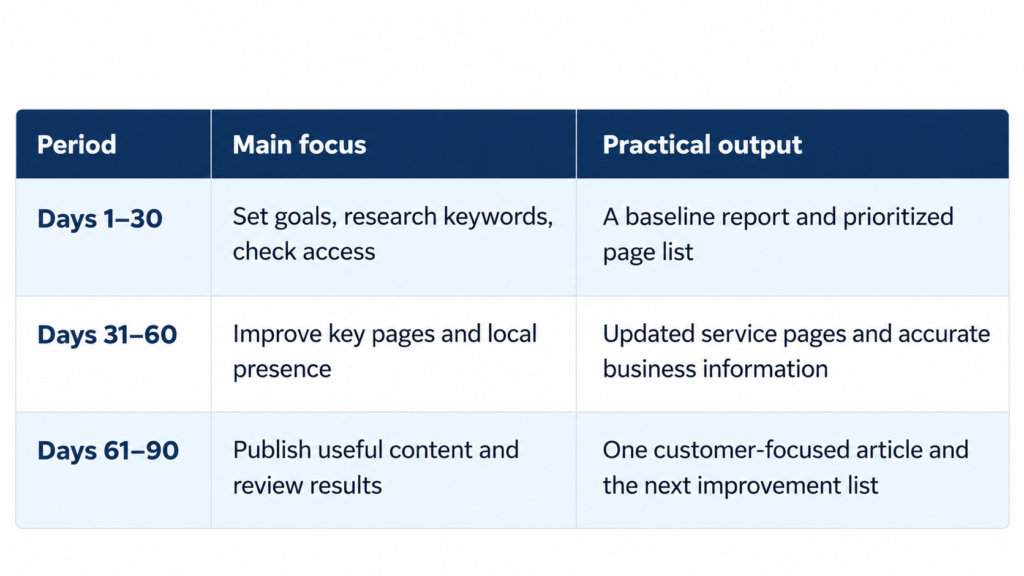
Treat this as an implementation schedule, rather than a deadline for rankings. Assign each task to someone and reserve a recurring time slot to complete it.
Need Help Putting Your SEO Plan Into Action?
Effective SEO for small businesses requires clear priorities and consistent follow-through. If your team needs support, speak with Pixel Technolabs, a Digital Marketing Agency in USA, about keyword research, website improvements, and an SEO plan built around your business goals.