
Key Takeaways:
- Ads Are Live Now: OpenAI confirmed ChatGPT ads are active for free-tier users in select markets including the US.
- Intent Drives Targeting: These new placements use conversational intent signals, not cookies or keyword bids, to surface relevant ads.
- Labeled as Sponsored: All placements are clearly marked as sponsored OpenAI has committed to full transparency with users.
- Paid Users See Less: ChatGPT Plus subscribers currently see fewer ads; the free tier is the primary ad-supported surface.
- Not Like Google Ads: Conversational context, intent depth, and measurement differ structurally from traditional search ads.
- Copy Tone Matters: Ad creative needs a conversational, informational register traditional promo language underperforms.
- Measure Early, Often: Attribution frameworks for AI-surface ads are still forming; early testers will define the playbook.
- Act Before It Scales: Early movers on new ad surfaces historically capture lower CPCs and stronger positioning advantages.
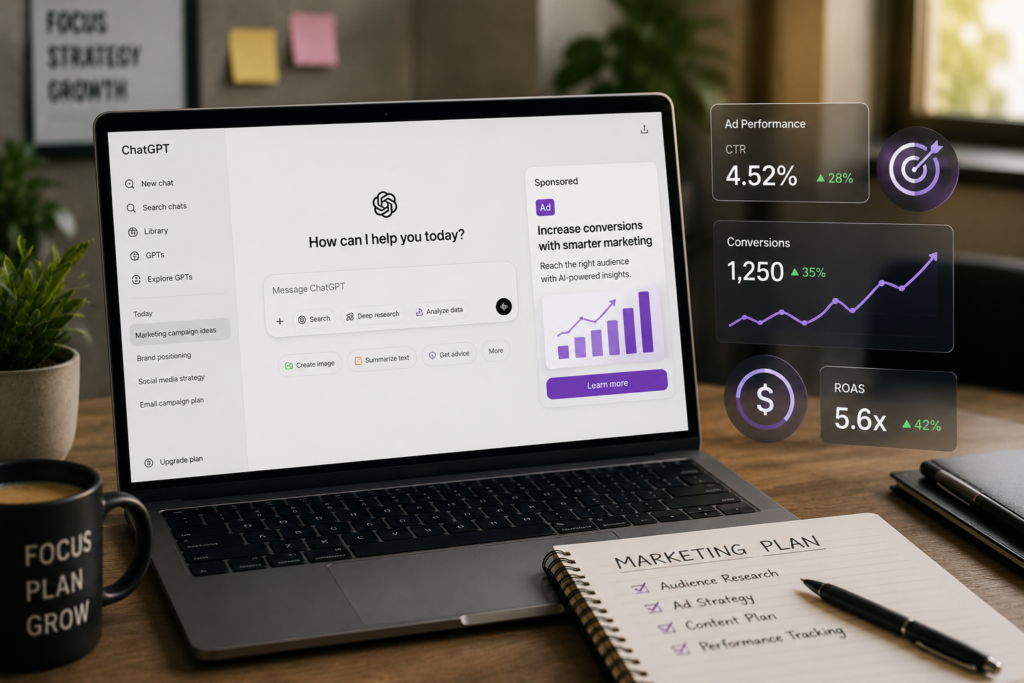
For years, Google owned the starting point of the customer journey. Someone needed a dentist, a project management tool, or a recipe for banana bread. They searched Google, ads appeared, and the click economy churned along. That starting point is shifting. A growing number of users now open ChatGPT first. And OpenAI has confirmed what many suspected was coming: ads are entering the picture.
This shift matters for every brand investing in paid marketing. Understanding how this new ad surface works, who it reaches, and what it means for digital marketing strategy is no longer a future conversation. It’s a now conversation. For any digital marketing agency in USA looking to stay ahead of channel diversification, this is worth paying close attention to.
What Are ChatGPT Ads and How Did We Get Here?
OpenAI launched ChatGPT as a purely ad-free product. That was part of its appeal. No sponsored results, no keyword bidding, no banner clutter, just answers. The business model ran on subscriptions and API revenue.
But with hundreds of millions of active users and a free tier that costs real money to run, the commercial logic of advertising has always been in the background. In 2025, OpenAI confirmed it is testing and rolling out ChatGPT ads initially in select markets and surfaces, with a stated commitment to keeping the experience relevant and non-intrusive.
The format isn’t a straight copy of Google Search ads. These placements are designed to surface within conversational responses appearing when a user’s query has clear commercial intent, labeled as sponsored content rather than woven invisibly into generated text.
How ChatGPT Ads Actually Work
The mechanics differ meaningfully from traditional search advertising, and understanding the distinction matters before allocating budget.
Conversational context targeting: Rather than matching ads to keywords, the system reads conversational intent. A user asking “what’s the best CRM for a small sales team?” signals purchase intent just as clearly as a Google search possibly more so, because the question is more specific. The platform identifies those signals and surfaces relevant sponsored content accordingly.
Clearly labeled sponsored placements: OpenAI has stated that all placements will be transparently labeled as sponsored. This is both a regulatory necessity and a trust protection. The perceived neutrality of ChatGPT’s responses is a core part of its value proposition, and blurring that line would damage user confidence quickly.
Response-adjacent placement: Current indications suggest ads appear adjacent to or following the AI’s organic response not embedded within the generated answer itself. This mirrors how Google separates ads from organic results, preserving the integrity of the core answer while creating a commercial layer around it.
No cookies, different data signals: Traditional display advertising relies heavily on cookie-based tracking. This new surface draws on conversational signals what the user is asking, in what context, with what apparent intent rather than browsing history. That’s a significant structural shift for anyone running paid marketing campaigns who is used to behavioral targeting.
Who Currently Sees ChatGPT Ads?
The rollout is staged and geographically selective. As of mid-2025:
- Active for free-tier users in select markets, including the United States
- ChatGPT Plus subscribers (paid users) currently see fewer or no ads OpenAI has positioned the ad-free experience as part of the paid tier’s value
- The ChatGPT mobile app and web interface are the primary surfaces; API access remains ad-free
- Business and enterprise accounts operate under separate terms and are not part of the consumer rollout
The free user base is enormous, and it skews toward curious, research-oriented behavior. That’s a commercially valuable audience for advertisers in education, SaaS, consumer services, and professional tools. Any digital marketing agency in USA running performance campaigns for clients in these verticals should be monitoring this platform closely.
Why ChatGPT Ads Are Different From Google Ads And Why That Matters
Marketers who treat these as just Google ads on a different interface will likely be disappointed. The differences are structural, and they affect how advertising budgets should be allocated going forward.
Key Structural Differences Between ChatGPT and Google Advertising
Intent depth vs. intent breadth: Google captures a vast range of intents from fully formed purchase decisions to idle curiosity. ChatGPT queries tend to skew toward research, comparison, and decision-support. Users are often further along in their thinking, making this surface particularly valuable for considered purchase categories.
Conversation length and context: A Google search is typically a single query. A ChatGPT session can involve multiple follow-up questions, refinements, and comparisons within one conversation. Ad targeting can theoretically use the full conversation context a richer signal than any single keyword.
Measurement is at an early stage: Google Ads has two decades of attribution infrastructure. The measurement frameworks for AI-surface placements impressions, clicks, and conversions are still being defined. Early adopters will build the playbooks everyone else follows.
Brand safety considerations: In search advertising, you bid on keywords. In conversational AI advertising, your ad may appear adjacent to a response on a broad topic. The brand safety implications require different monitoring approaches compared to traditional advertising channels.
What This Means for Your Digital Marketing Strategy
ChatGPT ads don’t replace existing channels they extend them. But they do require strategic reorientation for anyone thinking seriously about digital marketing today.
Reconsider what “search” means: AI-assisted search is now a distinct behavior from traditional search. Users who ask ChatGPT product questions before visiting a website represent a pre-search discovery moment that wasn’t previously capturable. This new ad surface creates a touchpoint at exactly that moment.
Content and ad copy need a conversational register: Creative designed for banner placements or keyword-matched text ads won’t automatically translate here. Copy that reads naturally within an informational context specific, credible, low-pressure will likely outperform traditional promotional language.
Monitor brand mentions in AI responses: Whether or not you advertise on ChatGPT, your brand may already be appearing or notably absent in AI-generated answers. Understanding how AI models describe your products, services, and competitors is fast becoming a distinct discipline in its own right.
Early mover advantage is real but temporary: New advertising surfaces reward early adopters with lower competition and lower CPCs before auction dynamics normalize. The marketers who tested Google Search ads in 2002 or Facebook ads in 2009 captured significant early-mover value. We’re at a similarly early inflection point right now.
How to Prepare for ChatGPT Ads
You don’t need a live campaign running tomorrow. But there are practical steps worth taking now:
- Audit your existing ad creative for conversational tone promotional language that feels natural on a landing page may feel jarring in an AI-adjacent context
- Track your brand’s AI visibility run regular checks on how ChatGPT and other AI tools describe your business and key differentiators
- Build out your knowledge base and structured content AI systems pull from well-structured content; your content quality directly affects how AI represents you
- Stay close to OpenAI’s advertiser announcements formats and targeting options are actively evolving; what’s true today may shift within a quarter
- Allocate a test budget structured early tests generate learnings that inform larger commitments down the line
The brands that treat ChatGPT ads as a future consideration rather than a current priority will find themselves behind when the platform reaches full scale.
Conclusion
This new ad surface marks the first serious challenge to Google’s monopoly on intent-based advertising in two decades, and they work differently enough that existing paid marketing playbooks won’t transfer cleanly. The targeting logic, creative requirements, measurement infrastructure, and user mindset are all distinct. Businesses that approach this as just another channel to plug existing campaigns into will likely underperform. Those who treat it as a new surface requiring fresh strategic discipline will be far better positioned as the platform scales.
The opportunity is real, but the window for low-competition early testing won’t stay open indefinitely. If you’re evaluating how AI advertising fits into your broader strategy, Pixel Technolabs helps businesses navigate exactly this kind of inflection point from auditing current digital presence to building campaigns suited to where search behavior is actually heading. The shift is already underway; the question is whether your strategy is moving with it.