
Key Takeaways:
- AI Search Shift: Shopping visibility now depends on AI recommendations, not only classic Google keyword rankings alone.
- Intent Wins: AI shopping search rewards products that clearly match buyer needs, budgets, and real use cases fast.
- Feed Accuracy: Updated product feeds help AI systems trust pricing, stock status, categories, and product details daily.
- Schema Matters: Product, review, FAQ, and offer schema help search engines understand ecommerce pages more clearly now.
- Trust Drives AI: Reviews, ratings, policies, and brand credibility strongly influence how AI recommends products online.
- Track New Data: Brands must monitor AI referrals, search queries, feed health, and product page conversions closely.
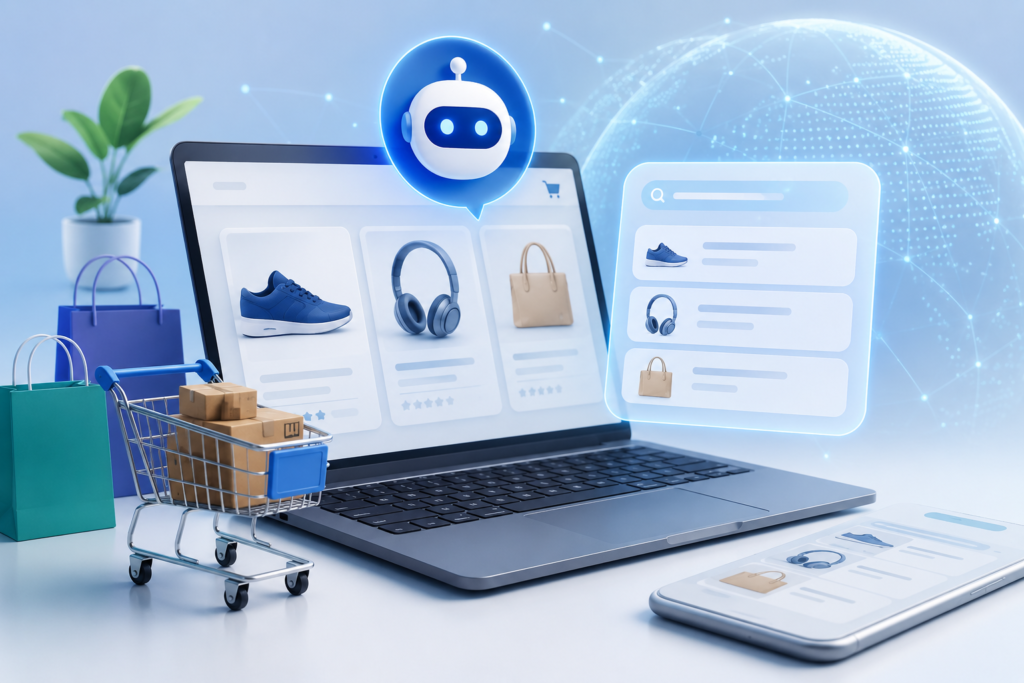
ChatGPT shopping search is changing the way customers discover products online. Instead of relying only on traditional Google searches, shoppers are now asking conversational questions to AI platforms before making buying decisions.
People no longer search only with short keywords like “wireless headphones” or “office chair.” They ask detailed questions such as:
- “What are the best noise-canceling headphones under $150?”
- “Which ergonomic chair is best for long work hours?”
- “Suggest affordable skincare products for dry skin.”
This shift is transforming ecommerce SEO, product discovery, and digital marketing strategies.
For ecommerce brands, visibility is no longer just about ranking on Google. It is also about becoming part of AI-generated recommendations, conversational shopping experiences, and personalized search journeys.
Businesses that improve their ecommerce SEO strategy, product data quality, and AI-friendly content structure will be in a much stronger position as AI-powered shopping continues growing.
What Is ChatGPT Shopping Search?
ChatGPT shopping search refers to AI-powered product discovery where users interact with conversational AI instead of browsing traditional search result pages.
Unlike standard search engines that mostly rely on keyword matching, AI shopping systems understand:
- User intent
- Context
- Budget preferences
- Product requirements
- Usage scenarios
- Buying goals
For example, a customer may search:
“What’s the best lightweight laptop for students under $800?”
AI systems analyze the request, compare available information, and recommend products that best match the user’s needs.
This changes how ecommerce businesses approach:
- Ecommerce SEO services
- Product content optimization
- AI SEO strategies
- Product feed management
- Digital marketing campaigns
The focus is moving away from simple keyword rankings toward relevance, trust, and conversational search optimization.
Why AI Shopping Search Matters for Ecommerce Businesses
Consumer behavior is changing quickly. Modern shoppers want fast answers, personalized recommendations, and simplified buying decisions.
Instead of opening multiple tabs and comparing products manually, users increasingly depend on AI-generated product summaries and recommendations.
This creates both opportunities and challenges for ecommerce brands.
Businesses that optimize their ecommerce websites for AI search can improve:
- Product visibility
- Conversion rates
- Customer engagement
- Organic traffic quality
- Shopping experience performance
At the same time, brands with poor product data, weak content, or outdated SEO strategies may lose visibility in AI-generated shopping experiences.
This is why ecommerce SEO services and AI search optimization are becoming essential parts of modern digital marketing strategies.
How AI Is Changing Product Discovery
Traditional ecommerce search was heavily keyword-driven. AI-powered shopping is much more intent-focused.
Instead of simply matching search terms, AI systems try to understand what the customer is actually trying to achieve.
For example, when someone asks:
“What’s the best office chair for lower back pain?”
AI evaluates multiple factors such as:
- Comfort
- Ergonomics
- Reviews
- Pricing
- Material quality
- Use-case relevance
This creates a more personalized and conversational shopping journey.
Users can continue refining their requests naturally:
- “Show cheaper options.”
- “What has better reviews?”
- “Suggest something for small spaces.”
This conversational flow is one of the biggest reasons AI shopping search is growing rapidly.
How ChatGPT Shopping Search Works
AI shopping systems rely heavily on structured product information and contextual understanding.
They analyze multiple data points, including product titles, descriptions, specifications, pricing, reviews, and product attributes.
The better your product data is organized, the easier it becomes for AI systems to understand and recommend your products.
AI-powered shopping platforms also rely on natural language processing to interpret conversational queries.
For example, when someone asks:
“Suggest waterproof hiking shoes for winter travel.”
The AI understands:
- Product category
- Weather condition
- Usage purpose
- Feature requirement
- Buying intent
This is why ecommerce content should sound natural, clear, and human-focused rather than overly optimized for keywords.
Key Ranking Factors for AI Shopping Visibility
High-Quality Product Content
AI systems prioritize detailed, accurate, and trustworthy product information.
Generic manufacturer descriptions often perform poorly because they do not provide enough contextual value.
Strong ecommerce product pages should include:
- Clear product descriptions
- Real product benefits
- Usage-focused explanations
- Specifications and dimensions
- Natural conversational language
Content should help both users and AI systems understand what the product does and who it is best for.
Structured Product Data
Structured data plays a major role in AI shopping visibility.
Schema markup helps search engines and AI systems interpret product information correctly.
Important schema types include:
- Product schema
- Review schema
- FAQ schema
- Offer schema
Structured ecommerce SEO improves visibility across:
- Google Shopping
- AI-generated product summaries
- Rich search results
- Conversational search engines
Reviews and Trust Signals
Customer reviews are becoming increasingly important for AI-powered shopping recommendations.
AI systems use reviews to evaluate product quality, customer satisfaction, and overall trustworthiness.
Strong trust signals include:
- Verified reviews
- Product ratings
- Clear return policies
- Customer support details
- Transparent shipping information
Positive user-generated content can significantly improve ecommerce visibility.
Website Authority
AI search systems also evaluate broader brand credibility.
Brands with strong topic authority and consistent ecommerce content tend to perform better in AI-driven shopping experiences.
This is where content marketing services and ecommerce SEO work together.
Helpful blog content, buying guides, comparison articles, and educational resources help strengthen brand authority over time.
Ecommerce SEO Strategies for AI Search
Create Conversational Content
Modern ecommerce SEO is moving toward conversational optimization.
Businesses should create content that directly answers customer questions in a natural way.
For example:
- “Which laptop is best for remote work?”
- “How long does this battery last?”
- “What’s the difference between these two models?”
Adding FAQ sections to product pages can improve both user experience and AI discoverability.
Optimize Product Pages
Product pages should now function as both sales pages and trusted information sources.
Every ecommerce product page should include:
- Clear headings
- Product specifications
- Comparison-friendly information
- FAQ sections
- Internal links
- Natural keyword placement
This helps search engines and AI systems better understand product relevance.
Improve Technical SEO
Technical SEO remains critical for ecommerce visibility.
Even the best content can struggle if a website has poor performance or crawlability issues.
Important technical SEO areas include:
- Fast-loading pages
- Mobile optimization
- Crawlable website architecture
- Clean URL structure
- Proper indexing setup
Businesses investing in ecommerce website development should prioritize both user experience and technical performance.
Product Feed Optimization for AI Shopping
Product feed optimization is becoming increasingly important for AI-powered ecommerce visibility.
AI systems rely heavily on structured product feeds to generate accurate shopping recommendations.
Every product feed should contain:
- Accurate product titles
- Correct categories
- Detailed attributes
- Updated pricing
- Real-time stock availability
- High-quality product images
Poor product feed quality can reduce visibility across both Google Shopping and AI shopping platforms.
Google Merchant Center also remains an important part of ecommerce SEO and shopping visibility strategies.
Businesses should regularly:
- Fix feed errors
- Update inventory
- Optimize product images
- Maintain pricing consistency
This helps improve product discoverability across multiple shopping ecosystems.
Role of Content Marketing in AI Shopping Search
AI systems rely heavily on informative and trustworthy content when generating recommendations.
This makes content marketing an important part of ecommerce SEO strategies.
Brands should focus on creating:
- Buying guides
- Product comparison articles
- Educational ecommerce blogs
- Industry-focused content
- FAQ resources
Strong content helps businesses build topical authority, improve organic visibility, and support AI-generated shopping recommendations.
For digital marketing agencies, this creates growing opportunities in:
- Ecommerce SEO services
- AI SEO optimization
- Content marketing strategy
- Product content optimization
- Ecommerce website optimization
Voice Search and Conversational Commerce
Voice search is also influencing ecommerce behavior.
Voice-based shopping queries are usually longer and more conversational than traditional searches.
Instead of typing:
“Bluetooth speaker”
Users may ask:
“What’s the best waterproof Bluetooth speaker for travel?”
This is why businesses should optimize for:
- Long-tail keywords
- Question-based searches
- Conversational content
- FAQ-focused SEO
Voice search optimization and AI search optimization are becoming closely connected.
Challenges of AI Shopping Search
AI-powered shopping search also introduces new challenges for ecommerce businesses.
One major challenge is reduced click-through opportunities.
AI-generated summaries may provide answers before users even visit a website, increasing competition for visibility inside recommendation results.
Businesses also become more dependent on accurate product data. Incorrect pricing, outdated inventory, or poor categorization can negatively affect AI visibility.
Another challenge is increased competition. AI systems may recommend fewer products compared to traditional search results, making trust, relevance, and product quality even more important.
How Ecommerce Brands Should Prepare for AI Search
Businesses should focus on three major priorities moving forward.
First, improve product data quality by maintaining accurate feeds, updated inventory, and structured schema markup.
Second, build conversational and helpful ecommerce content that answers real customer questions.
Third, invest in ecommerce SEO strategies that support both traditional search engines and AI-powered shopping platforms.
This includes:
- Technical SEO
- Semantic SEO
- AI-friendly content
- Product feed optimization
- Structured data implementation
Brands that adapt early will have a stronger advantage as AI shopping search continues evolving.
Final Thoughts
ChatGPT shopping search is changing ecommerce visibility in significant ways. Traditional keyword rankings still matter, but AI-generated recommendations, semantic relevance, and structured product information are becoming equally important.
Businesses that improve ecommerce SEO, optimize product feeds, create conversational content, and strengthen trust signals will be better positioned for AI-driven shopping discovery.
As conversational commerce continues growing, brands need to focus on creating AI-friendly ecommerce experiences that are helpful, structured, and trustworthy.
At Pixel Technolabs, we help businesses improve ecommerce visibility through ecommerce SEO services, AI-ready content strategies, ecommerce website optimization, and modern digital marketing solutions designed for the future of AI-powered search.